
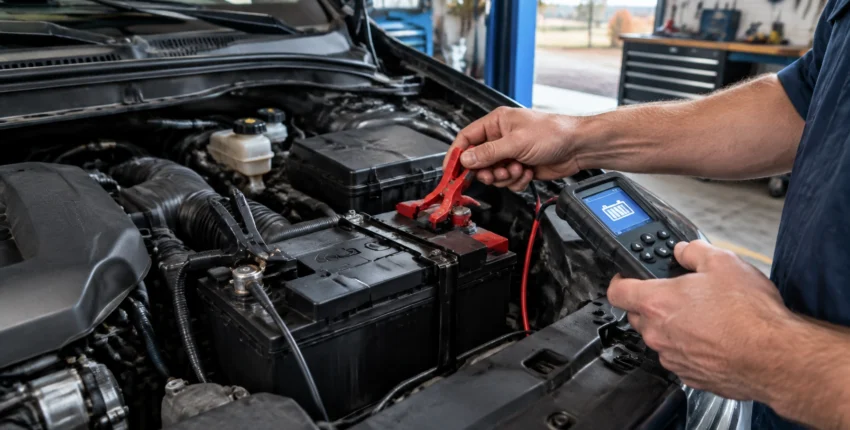
Late September is a good time to think about your car battery: not because winter has arrived, but because the first hard freeze can expose a battery that seemed perfectly fine all summer.
Drivers around Petersburg, Athens, Pleasant Plains, Ashland, Chandlerville, Tallula, and Greenview often depend on their vehicles for work, school, errands, and longer trips across Central Illinois. A no-start on a cold morning is more than an inconvenience. It can make you late, leave you waiting outside, or strand you along a rural road.
The good news is that many cold-weather battery failures are predictable. A battery inspection, terminal check, and proper load test at a trusted auto repair shop in Petersburg, IL can help you address a weak battery before the temperature drops.
Why cold weather causes battery trouble
A car battery stores energy through a chemical reaction. When temperatures fall, that reaction slows down, and the battery cannot deliver electricity as easily. At the same time, your engine requires more power to start.
That combination is what makes a cold snap so hard on an aging battery:
- The battery’s available output decreases.
- Cold engine oil becomes thicker and harder for the starter to turn.
- Your vehicle may be using more electrical accessories, including headlights, the heater blower, defroster, and heated seats.
- Short winter trips may not give the alternator enough time to replace the energy used during starting.
At around freezing temperatures, a battery can lose a noticeable amount of available power. Around 0°F, the reduction can become much more significant. A battery with just enough strength to start your vehicle on a mild October morning may not have enough reserve for a bitter January start.
Cold weather usually does not drain a healthy battery by itself overnight. Instead, it reveals existing weakness caused by age, repeated deep discharges, heat-related damage, internal wear, or poor electrical connections.
The 3-year rule: a useful battery warning
Most automotive batteries last approximately three to five years, but that range is not a guarantee. Driving habits, under-hood heat, extreme temperatures, vehicle electronics, and maintenance all affect battery life.
The practical “3-year rule” is simple: once your battery reaches about three years old, have it tested before the winter season. You may not need to replace it immediately, but you should know how much starting capacity remains.
Battery age matters because summer heat often causes much of the long-term damage. High temperatures accelerate corrosion and deterioration inside the battery. The battery may continue starting the car through warm weather, but the first serious cold snap places much greater demand on it.
Look for a date sticker or stamped code on the battery case. If you cannot identify its age, a mechanic in Petersburg, IL can inspect it and check its condition.
Consider testing or replacing the battery sooner if you notice:
- Slower-than-usual engine cranking
- Clicking when you turn the key or press the start button
- Flickering interior or exterior lights
- Electrical accessories that seem weaker than normal
- A battery warning light
- Corrosion around the terminals
- The need for repeated jump-starts
- A vehicle that sits for several days at a time
The 3-year guideline is not a rigid expiration date. A well-maintained battery may last longer, while a heavily used battery may fail sooner. Testing is more reliable than guessing.
What a load test tells you that a voltage check does not
A simple voltage check is useful, but it only tells part of the story.
When a battery is sitting unused, a voltage reading can indicate its approximate state of charge. For example, a battery may show a normal-looking voltage after being charged or driven recently. That does not necessarily mean it can produce enough power to start the engine on a cold morning.
A load test evaluates what happens when the battery has to work. Depending on the vehicle and equipment, a shop may use a traditional load test or a modern electronic conductance tester. The test checks whether the battery can maintain sufficient voltage while supplying substantial current, similar to the demand created by the starter motor.
Technicians may compare the battery’s measured performance with its rated cold cranking amps, or CCA. CCA describes how much current a battery can provide for starting in cold conditions under a defined testing standard.
A weak battery can pass a basic voltage check but fail under load. That is why professional testing is valuable before the first hard freeze. It helps identify a battery that is charged but no longer strong enough to deliver dependable starting power.
A proper battery evaluation may also include checks of:
- Battery age and physical condition
- Terminal tightness and corrosion
- Charging voltage from the alternator
- Starting-system performance
- Parasitic electrical draw if the battery repeatedly loses charge
If the battery tests well but keeps going dead, the battery may not be the root cause. An alternator problem, wiring fault, excessive parasitic draw, or repeated short-trip driving pattern could be contributing to the issue. That is where engine diagnostics in Petersburg, IL can help.
How to recognize and safely address terminal corrosion
Battery terminal corrosion often appears as a white, pale blue, or greenish buildup around the posts and cable clamps. It can form when battery gases or moisture react with the metal.
Even a small amount of corrosion can create resistance in the connection. Think of it like a partially closed water valve: electricity may still pass through, but not as freely as it should. That resistance can make starting more difficult and prevent the battery from charging efficiently.
If you inspect the battery, look for:
- Powdery buildup around either terminal
- Loose cable clamps
- Frayed or swollen battery cables
- Cracked battery housing
- Dampness or signs of leakage
- Corrosion spreading onto the cable ends
If you are comfortable performing a basic inspection, turn the vehicle off and keep sparks, cigarettes, and open flames away from the battery. Wear eye protection and gloves. Do not use a metal tool in a way that could connect the positive terminal to nearby metal parts.
For light surface corrosion, a battery-terminal cleaning brush and an appropriate battery-cleaning product can help. The cable clamps should be disconnected and reinstalled correctly, with the negative connection removed first and reconnected last. The terminals and clamps should be dry, clean, secure, and protected as recommended by the vehicle or battery manufacturer.
However, corrosion can be a symptom of a larger problem. A damaged cable, overcharging condition, leaking battery, or poor connection may need professional attention. If the battery case is cracked, swollen, leaking, or badly corroded, do not try to clean it yourself. Have a qualified technician inspect it.

Why a pre-freeze inspection is worth your time
Waiting until the first freezing morning to find out whether your battery is healthy is a risky strategy. By then, many other drivers may be dealing with the same problem, and a tow or emergency jump-start can disrupt your entire day.
A quick visit before winter can identify several issues at once:
- Battery condition: Is it holding a charge and producing adequate starting power?
- Terminal condition: Are the connections clean, tight, and able to carry current?
- Charging system: Is the alternator replenishing the battery properly?
- Starting system: Is the starter drawing more power than it should?
- Electrical concerns: Is something draining the battery while the vehicle is parked?
This is a small investment compared with the cost and inconvenience of being stranded. Preventive car maintenance in Petersburg, IL works much like checking the roof before a storm: it is easier to correct a small weakness while conditions are manageable than to deal with the consequences during the worst weather.
Simple ways to reduce winter battery strain
A battery test is the best starting point, but a few habits can also help:
- Avoid leaving lights, chargers, or accessories on when the engine is off.
- Combine short errands when possible so the vehicle has more time to recharge.
- Keep battery terminals and cable connections clean.
- If your vehicle sits for extended periods, ask about a battery maintainer.
- Pay attention to slow cranking instead of waiting for a complete no-start.
- Replace an aging battery before its performance becomes unreliable.
- Make sure the battery has an appropriate CCA rating for your vehicle and climate.
These steps cannot prevent every battery failure, but they reduce the risk and give you an earlier warning when something is wrong.
Get ready before the first hard freeze
A cold snap rarely creates a battery problem from nothing. More often, it exposes a battery that was already aging, undercharged, corroded, or struggling to meet the vehicle’s starting demands.
If your battery is around three years old, showing corrosion, or cranking more slowly than usual, schedule an inspection before Central Illinois temperatures fall sharply. Kerrigan’s Automotive services all makes and models and offers same-day service for most repairs. Our team can test the battery, inspect the terminals, evaluate the charging system, and help you decide whether replacement or another repair makes sense.
Book your visit with Kerrigan’s Automotive before the first hard freeze: and start the season with greater confidence that your vehicle will be ready when you are.